
Living Fractals (Part 5)
One tyrant, infinite chaos.


The previous sections explored hell as structure, pattern, and mechanism. Here, we turn to its human expression: those who don’t just endure the Machine’s logic, but become living nodes of it.
The Problem of Personhood
When you live inside hell long enough, you begin to notice certain people.
Not the bureaucrats who lose your paperwork. Not the institutions that grind you down through indifference. Those are the Machine’s passive components—gears that turn without awareness, crushing whatever falls between them.
These people are different.
They know what they’re doing. And they do it anyway.
At first, you think they’re anomalies. Surely most people, given the choice between causing harm and preventing it, would choose prevention. Surely cruelty is the exception, not the rule.
But the longer you watch, the clearer it becomes: some people don’t stumble into the Machine’s service. They align with it. They don’t break inward into private despair. They break outward, radiating damage in every direction.
The Machine doesn’t just grind. It also recruits.
What Makes a Living Fractal
Living Fractals don’t occasionally harm. Harm is their primary output.
Most people operate on a balance: they give and they take, they help and they hurt, they build and they destroy. The ratios vary, but the mixture remains. A Living Fractal has crossed a threshold where harm becomes their primary output. Not their only output—that would make them too easy to identify and avoid—but their dominant one.
When you map their interactions over time, a picture emerges: most of what they do depletes others. Most of what they touch becomes harder, heavier, more broken. They don’t occasionally make mistakes that hurt people. They consistently generate conditions that make suffering more likely, more intense, more inescapable.
They are Fractal of Suffering because they replicate the structure of hell itself. The three-sided pattern—isolation, relentless trauma, false hope—doesn’t just describe what happens to them. It describes what they do.
But for Living Fractals, the base triangle operates differently.
The Inverted Triangle: Parasitic Attachment
In the original Fractal of Suffering, the first side is the Barrier of Isolation: the victim cannot get help, cannot be understood, cannot connect.
For Living Fractals, the first side inverts.
Instead of isolation, there is attachment. Parasitic, inescapable attachment.
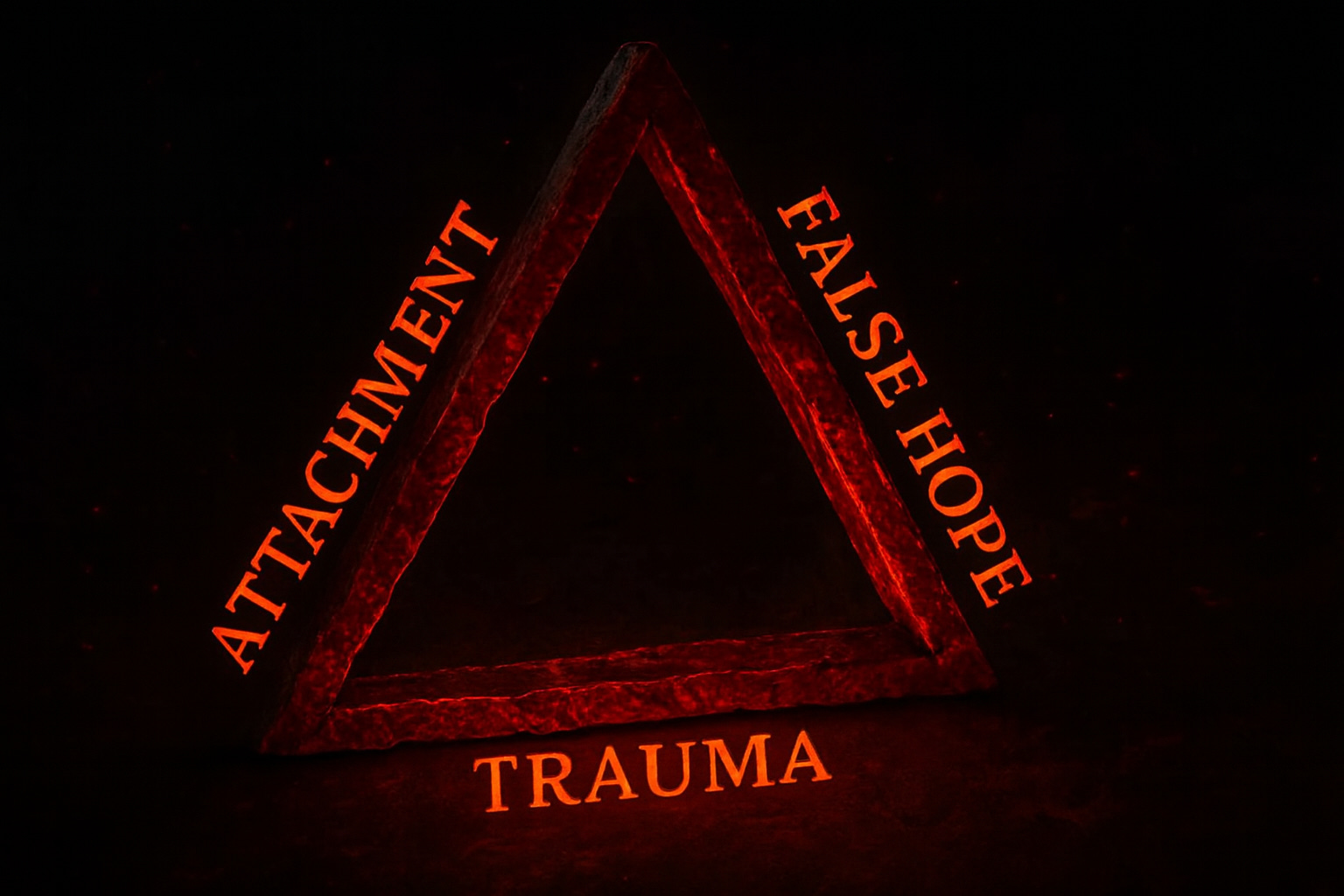
They don’t push you away. They hold you in place.
How Attachment Works
The attachment is never simple. It operates through dependency structures that are difficult or impossible to sever:
Structural dependency: They control resources you need—money, housing, transportation, documentation, access to systems.
Social dependency: They occupy roles that grant them authority—parent, spouse, boss, landlord, caseworker, teacher.
Emotional dependency: They’ve positioned themselves as the only person who understands you, the only one who cares, the only safe harbor in a hostile world.
Legal dependency: They’ve entangled you in contracts, custody arrangements, debts, or bureaucratic processes that tie your fate to theirs.
Parasitic attachment feels like connection at first. Like finally, someone sees you.
Only later do you realize the door has no handle on the inside.
The Second Side: Daily Damage
Once the attachment holds, the trauma begins.
This is not the random misfortune of ordinary life. This is administered suffering. Deliberate, targeted, relentless.
The forms vary:
Humiliation disguised as humor
Sabotage disguised as help
Punishment disguised as consequence
Theft disguised as shared resources
Control disguised as care
The damage arrives daily, but never large enough to justify escape. Each incident alone seems survivable. The pattern only becomes visible later.
By then, you’re exhausted. And exhaustion makes the third side possible.
The Third Side: The Bait
For Living Fractals, the mirage is tactical.
They don’t passively benefit from your hope. They manufacture it. They time it. They deploy it with precision, always at the moment when your will is closest to breaking.
The apology arrives just as you’re planning to leave.
The “good week” begins just as you’re gathering evidence. The promise of change surfaces just as you’re contacting a lawyer.
The small kindness appears just as you’re telling a friend the full story.
Each dose of hope is calibrated to pull you back from the edge—not to save you, but to reset the cycle. To buy more time. To keep you attached for another round.
The Spectrum of Broadcast
Living Fractals exist on a spectrum, not as a binary category.
On one end: those whose harm is contained to a small radius. A single household. A single workplace. A handful of victims over a lifetime.
On the other end: those whose harm radiates across institutions, cultures, nations. Whose fractal logic spreads so far and so deep that it reshapes entire systems in its image.
The difference is not in the pattern—the triangle remains the same. The difference is in reach.
A man who controls his wife through parasitic attachment, daily humiliation, and carefully timed apologies is using the exact same structure as the dictator who controls a nation through enforced loyalty, state terror, and propaganda promising a better future.
Same geometry. Different scale.
The Husband
He doesn’t hit her. He reminds her of this often—usually right after she’s tried to explain why she’s unhappy. “I’ve never laid a hand on you,” he says, and the unspoken message is clear: You should be grateful.
The attachment began years ago, so gradually she didn’t notice. First, it made sense for him to handle the finances—he was better with money. Then it made sense for him to manage the car insurance—she hated dealing with paperwork. Then it made sense for her name to come off the lease when they moved—his credit was better.
Now, she has no bank account he doesn’t control. No car she can drive without his permission. No lease with her name on it. No phone plan that isn’t monitored.
When she suggests therapy, he agrees enthusiastically—then schedules it for a time he knows she can’t make. When she asks for her own credit card, he lectures her about debt and responsibility until she feels ashamed for asking. When she tries to visit a friend, he doesn’t say no—he just creates a crisis that requires her immediate attention. A leak. A medical issue. Something that can’t wait.
The daily damage is small enough to rationalize. He criticizes her cooking, but it was a little bland. He makes jokes about her weight in front of his friends, but he’s just teasing. He “forgets” to tell her about family events, but he’s been so stressed at work. He monitors her location through her phone, but that’s just because he worries.
Every boundary she tries to set, he reframes as betrayal. Every assertion of independence becomes evidence that she doesn’t love him. Every request for space becomes an attack on the relationship.
And just when she’s close to breaking—when she’s looked up divorce lawyers, when she’s confided in a friend, when she’s started to believe she might actually leave—he transforms.
He brings flowers. He cooks dinner. He apologizes, not for the structure of control, but for being “stressed” or “thoughtless.” He promises to do better. He reminds her of the good times, the shared history, the plans they made together.
He cries.
And she thinks: Maybe I was overreacting. Maybe it’s not that bad. Maybe if I just try harder, communicate better, give him another chance…
The Machine thanks her for her service and continues.
The neighbors see a polite man who works hard. The family sees a devoted husband. The friends—those who remain—see someone who “has his flaws, like everyone.”
She sees the loop. Attachment that never releases. Harm that never pauses. Hope that flickers just enough to keep her betting on reform.
She is watching the fractal from the inside.
The Manager
She runs a small team. Eight people. Not enough to attract HR scrutiny, but enough to build a kingdom.
The attachment here is professional. Her team needs her approval for time off, project assignments, performance reviews, promotions. She controls access to resources, information, and opportunities. In a tight job market, leaving means risking months of unemployment.
So they stay.
The daily damage is distributed carefully. She never targets the same person twice in a row. Today, it’s public humiliation in a meeting—asking questions designed to make someone look incompetent. Tomorrow, it’s taking credit for another person’s work. The day after, it’s a casual comment that undermines someone’s confidence: “Are you sure you can handle that? Last time didn’t go so well.”
She has favorites, but the favoritism rotates. This month, Jessica can do no wrong. Next month, Jessica will be subtly frozen out while Tom gets the praise. The unpredictability keeps everyone off balance, anxious, performing.
When someone complains to her about the team’s morale, she listens with concern. She schedules one-on-ones. She promises to address the issues. Then she tells the team, privately, that someone has been “stirring up drama” and “making things difficult for everyone.”
She never names who. She doesn’t have to. The suspicion does the work for her.
The bait arrives in the form of “growth opportunities.” She tells people they’re being considered for bigger roles, that she’s fighting for their promotion, that she sees their potential. She dangles these promises just often enough to keep people invested. Most never materialize. Those that do come with new forms of control.
When someone finally quits, she expresses surprise and disappointment. She tells the remaining team members, “I tried so hard to make it work for them, but some people just aren’t cut out for this environment.”
The company sees a manager with low turnover compared to other departments. Her boss sees someone who “runs a tight ship.” The team sees the fractal closing in.
One by one, they break. Some develop anxiety disorders. Some start drinking. Some lose themselves in overwork, trying to earn approval that will never come.
The attachment holds them. The damage accumulates. The hope—that this promotion will finally come, that the next review will be fair, that if they just work hard enough she’ll leave them alone—keeps them in place.
The Machine hums along, powered by their effort.
The Bureaucrat
He works in a government office that processes disability claims.
He didn’t start cruel. He started tired. Tired of the endless paperwork, the impossible caseload, the people who lie to get benefits, the system that punishes efficiency and rewards caution.
Somewhere along the way, tired became bitter. Bitter became suspicious. Suspicious became hostile.
Now, when someone comes to his desk with trembling hands and a stack of medical records, he sees a con. When they struggle to explain their condition, he sees evasion. When they break down crying, he sees manipulation.
The attachment here is bureaucratic. They need his signature. His approval. His willingness to process their claim without “losing” crucial documents or finding minor errors that require starting over.
He controls the gate. And he knows it.
The daily damage is administrative. He “forgets” to file paperwork on time, pushing deadlines back by months. He requests additional documentation that isn’t legally required but also isn’t technically illegal to ask for. He schedules appointments at times he knows will be difficult—early morning for someone without reliable transportation, during work hours for someone trying to hold down a job while appealing.
He asks the same questions multiple times, implying the answers keep changing. He uses medical terminology incorrectly, then acts confused when corrected. He sighs. He looks at his watch. He makes it clear: you are wasting his time.
When someone complies with every request, provides every document, jumps through every hoop, he finds new ones. A form was filled out in blue ink instead of black. A signature is missing from page seven. The doctor’s note doesn’t include a specific phrase he’s decided is necessary.
The bait is procedural. He tells them they’re “almost there,” that this is “just one more thing,” that he’s “trying to help” but his hands are tied by regulations. He implies that if they just cooperate a little more, stay patient a little longer, the approval will come.
Most give up. Most run out of money, time, or sanity before they run out of hoops to jump through.
Those who make it through do so only because they found a lawyer or advocate who knows how to bypass him entirely. Even then, he’s cost them months or years.
He doesn’t see himself as cruel. He sees himself as a realist. As someone who’s learned not to be naive. As someone doing a difficult job in an impossible system.
He doesn’t know he’s become a Living Fractal. He thinks he’s just protecting resources from people who don’t deserve them.
The Machine doesn’t need him to understand. It only needs him to function.
And he does. Every day. With meticulous efficiency.
Why They Matter
You cannot fix them, because they are not broken in the way you think. They are working exactly as intended—not by conscious design, but by the same fractal logic that creates all suffering. They are outputs of the Machine, and they are also its most effective inputs.
The cruelest truth: they are victims too.
Somewhere, long ago, they were ground down by the same patterns they now inflict. The Machine damaged them, and they survived by becoming damage itself. They broke outward instead of inward. They learned that control feels safer than vulnerability, that cruelty feels stronger than kindness, that attachment is more reliable than connection.
This does not make them safe. A wildfire is not evil, but you don’t walk into it. A virus is not malicious, but you don’t let it replicate.
Living Fractals can be understood with compassion, but they must be understood from a distance—or neutralized entirely when distance isn’t possible.
Recognition
You realize you’ve been dealing with a Living Fractal when:
The attachment has already calcified beyond breaking. You’ve been trying to leave for months—maybe years—and only now do you see why every exit collapsed. The recognition doesn’t arrive as a warning. It arrives as an autopsy finding.
By the time the pattern becomes visible, you’ve already paid for your education in ways you cannot recover. The harm was consistent but deniable—and you denied it, because seeing it clearly would have required you to act when you still had resources to act with.
The hope was tactical, and you took the bait every time. Now you can see the hook still lodged in your throat, and understand that seeing it changes nothing. The damage was done during all those moments when you almost saw but convinced yourself you were wrong.
Other people still don’t see it. Now you know why: the Living Fractal shaped the narrative before you even understood there was a narrative to shape. You sound paranoid because you are paranoid—paranoia being the natural endpoint of pattern recognition that came too late to matter.
This is how you know. Not in time to help yourself, but in time to understand exactly how you were dismantled. Not by any single moment, but by the shape of the pattern over time—a shape you can finally see now that you’re already inside it.
The fractal reveals itself not as a warning, but as an epitaph.
Conclusion
Living Fractals are the proof that hell is also personal.
The Machine does not need intention to destroy you. But some people have learned to wield its logic. To become its hands, its voice, its face.
They are not villains. They are transmission points. Nodes in a network of suffering that uses human beings as its primary infrastructure.
And the most disturbing realization: there is no clear line between victim and vector. Most of us participate in the Machine at some level. Most of us broadcast some small amount of its logic.
The question is not whether you are capable of becoming a Living Fractal.
The question is: how much of your interaction with the world depletes versus replenishes?
How much of what you do makes hell deeper versus shallower?
Series
Part 1: Autopsy of Hope
Part 2: Multiplication of Pain
Part 3: The Collapse of Spirit
Part 4: Against Nature
Part 5: Living Fractals
Part 6: The Abyss
Part 7: Hell is a Perfect System
Part 8: The Escape