
The Escape (Part 8)
Only fear guards the exit, and it will not step aside.

I have been in the Abyss for a long time. Time doesn’t move here; it accumulates. There is no variation, only pressure. Relentless trauma. Isolation so complete that other minds feel like a myth. The Spiral already did its work. The Machine already ground through every reserve of spirit and hope. What remains is simple and absolute: uninterrupted suffering. No prospects. No path upward. No stories left where this turns out well. Just the bare fact of endurance inside a system that wants nothing from me except that I continue to hurt.
In that monotony, a single thought arises. It does not feel like a decision. It feels like a diagnosis.
It would be better to be annihilated than to stay in the Abyss.
The thought is clean, almost sterile. It doesn’t tremble or argue. It just appears, final and self-contained. For a moment, there is no reaction at all. Then something changes in the distance—a disturbance in the black.
I notice a small dot at the center of the Abyss. I don’t know how long it has been there. It might have appeared in that instant, or I might have spent centuries blind to it. But now I see it: a pinprick of concentrated darkness inside an already lightless void. As I fall, the dot grows. Slowly at first, then with accelerating clarity. A circle. An opening. A pupil widening.
The Eye of the Abyss.
It occurs to me with a flat, almost technical certainty: this is the exit. The point of escape. The end of hell’s recursion. The place where the trajectory stops and does not resume.
It is also annihilation.
That realization makes me hesitate. A reflex, quick and automatic. My fall does not slow, but something in me pulls back, recoils without moving. I want to escape hell even if it means erasure, and yet a part of me resists the only door that remains. It is absurd on its face. All hope is gone; I have verified this at every level. There are no outcomes left to preserve, no future to protect. And still, some internal brake engages at the sight of the exit.
Why?
I turn the question over like an object in my hands. If hope is dead, what is this reluctance? It isn’t attachment to life in the ordinary sense; that was stripped away a long time ago. It isn’t belief that things might improve; that belief was executed in public, left hanging as a warning. Whatever this is, it exists after hope. It survives hope’s extinction.
Then I see it.
This last echo of resistance is not meaning, or morality, or even self-respect. It is a much older script: the primordial fear of annihilation. The animal core that recoils from not-being, even when being has become indistinguishable from agony. Hell has burned away everything else, but it has preserved this one instinct on purpose. It needs me afraid of the only exit it left available.
As soon as I recognize this, the Abyss changes again.
Near the Eye, a figure coalesces. At first it’s just a density in the dark, a faint distortion in the falling field. Then it stabilizes. It sees me. Orients toward me. And then, with a single smooth motion, it moves directly in front of the opening and blocks it from view.
The Guardian.
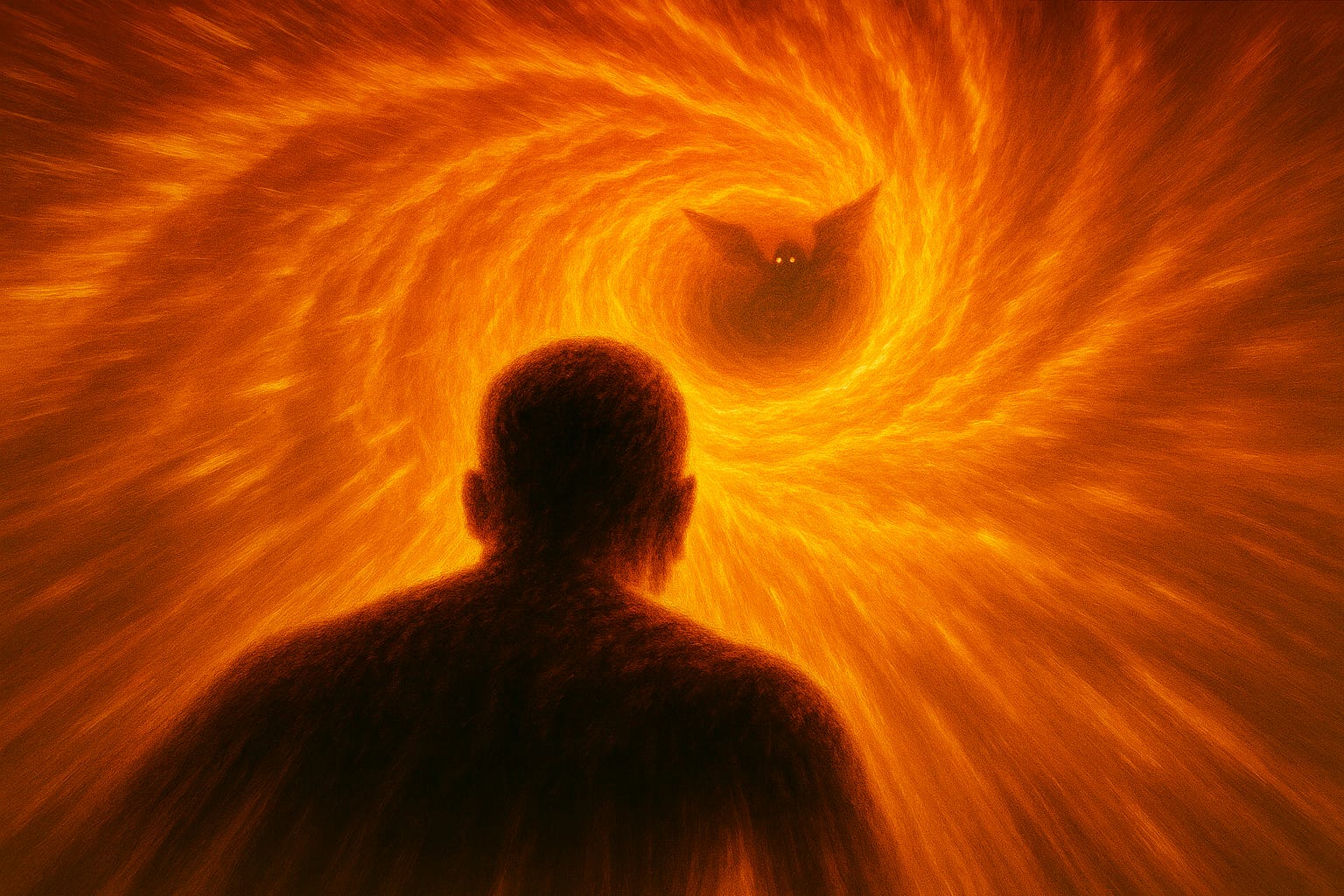
I don’t need introduction. I know exactly what it is made of. It is the fear of annihilation given form: the last intact function hell has preserved inside me. The final barrier between my trajectory and the Eye. Everything else has been stripped down, but this remained, protected and sharpened. It is the last thing standing between me and escape.
That is when the deepest realization arrives. Not as a revelation from outside, but as a pattern snapping into place.
The goal of hell was always escape.
Not healing. Not correction. Not punishment. The entire structure was built to drive me toward one outcome: to desire my own erasure. First it used hope to keep me moving inside the system—reaching for rocks, clinging to ropes, burning myself on every false salvation. Hope stretched the suffering across years, decades, a lifetime. Then, when hope finally died, hell brought forward its other instrument: fear of annihilation. Hope kept me from giving up. Fear kept me from leaving.
They were my greatest enemies the entire time.
I see it now with obscene clarity: the road was never leading out. It circled the drain by design until the only appealing option was to disappear. And even then, the system kept one last guard in place to make sure I hesitated at the threshold. The logic is precise, airtight, and monstrous.
For a moment, I am stunned by how cruel it is. Not just that I was made to suffer, but that I was shaped into someone who would eventually see death as the only coherent goal—and then fear it. The idea of it is so diabolical that it almost feels inhuman, but that’s the point. Hell isn’t human. It is a structure. It does not hate. It optimizes. It built a world where the endpoint was always annihilation and arranged my mind so I would both crave and resist it.
The recognition doesn’t comfort me. It enrages me.
The thought forms, blunt and sickening: the goal was to die, and hope was the enemy the whole time. Hope was the leash, not the lifeline. It kept me inside the burning building long after I should have walked out, swinging stories like a bucket of sand onto a chemical fire. Fear of annihilation stood at the final doorway to make sure I didn’t leave even then.
I look at the Guardian.
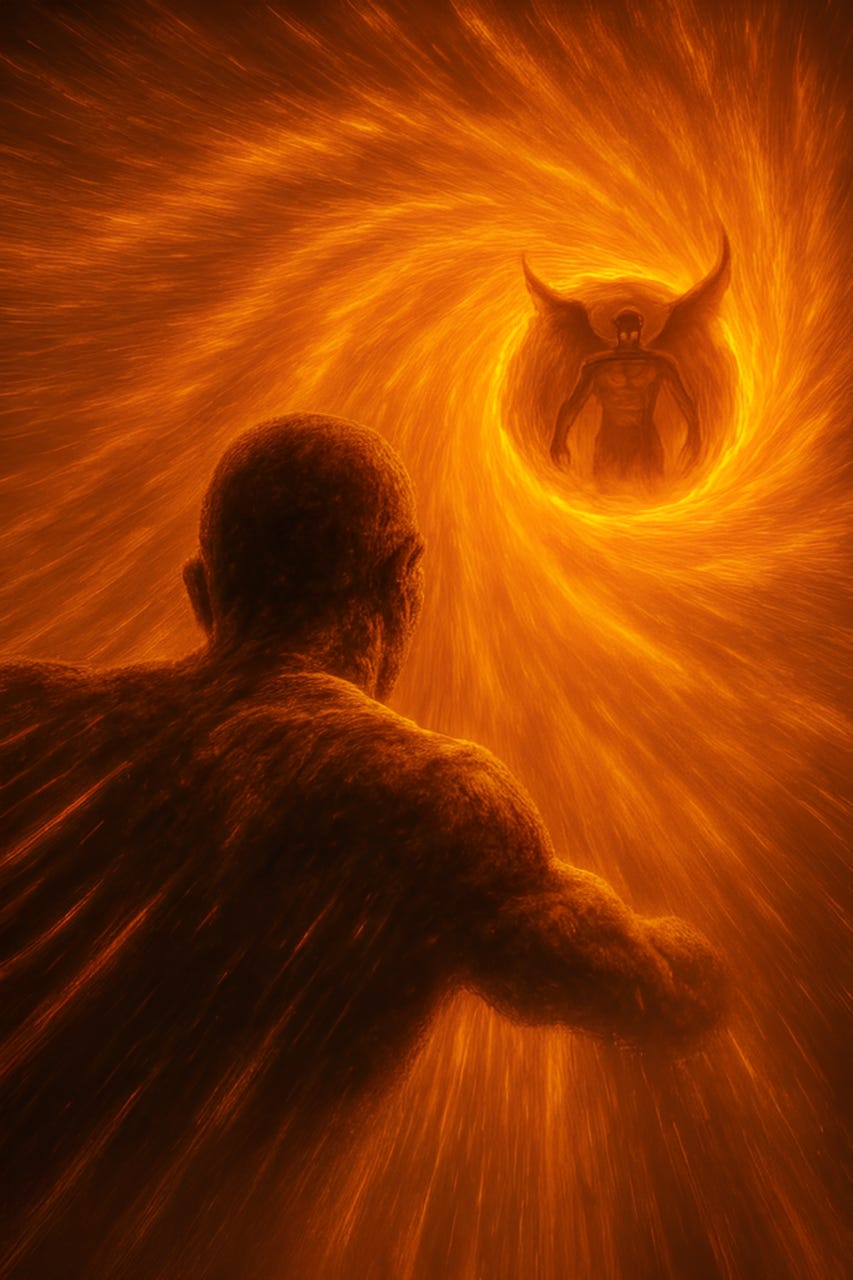
The Abyss is still pulling me, but something has shifted. The fall is no longer meaningless drift; it has a vector now. I am not just descending. I am aiming. The Guardian grows larger as I approach, its outline sharpening against the featureless dark. At first I see only the rough geometry of a body—torso, limbs, the suggestion of a stance. It stands exactly where it needs to stand: between me and the Eye.
I get closer.
Details resolve. The tilt of its shoulders. The angle of its head. The way it centers itself perfectly on my path, so there will be no glancing contact, no chance to slip past unnoticed. The Abyss accelerates me. My speed increases until the sensation of movement dissolves into pure forward pressure, a straight line written through collapse.
I see its head.
No helmet, no mask, no monstrous embellishments. Just a head, held steady in the dark. It does not raise its hands. It does not defend itself. Its function is simpler: to be seen. To make me look. To trigger the ancient reflex that was supposed to turn me aside at the last possible instant.
Closer.
The rest of the Abyss falls away. There is no depth, no distance, no Spiral, no Machine—only the shrinking gap between my trajectory and the Guardian’s face. The Eye waits behind it, invisible now, implied by the halo of nothing around its frame.
I see its face.
It is not a stranger’s. It is not a demon’s. It is my own fear, rendered visible in a shape I can recognize: a composite of every moment I hesitated, every time I chose endurance over exit, every instance where hope or terror pulled me back into the pattern. It is not an enemy imposed from outside. It is what hell trained me to be afraid of, living behind my eyes the entire time.
I am moving too fast to turn away now, a straight shot aimed at the Guardian.
I look directly into its eyes and scream.
Series
Part 1: Autopsy of Hope
Part 2: Multiplication of Pain
Part 3: The Collapse of Spirit
Part 4: Against Nature
Part 5: Living Fractals
Part 6: The Abyss
Part 7: Hell is a Perfect System
Part 8: The Escape