
Autopsy of Hope (Part 1)
Hope is the corpse. This is the autopsy.

Prologue: No Light at the End
This story isn’t about redemption or victory against the odds. It is an autopsy.
Hell is real. For the doomed and forgotten—those born there, living there, and dying there—no one knew, no one cared. This record is for them.
You don’t decide what happens here. Hell does. And sometimes, even death isn’t available to you. Hell’s greatest terror is that the only escape is oblivion, but you don’t get to choose when you leave.
My goal in hell wasn’t to find hope, but to abandon it. Before I left, I made this hatework. Hell isn’t a place—it’s an experience. It’s a machine.
Hell Theory: A Study of Subjective Suffering
Spirit and Hope
Spirit is endurance itself.
When spirit weakens, hope corrodes.
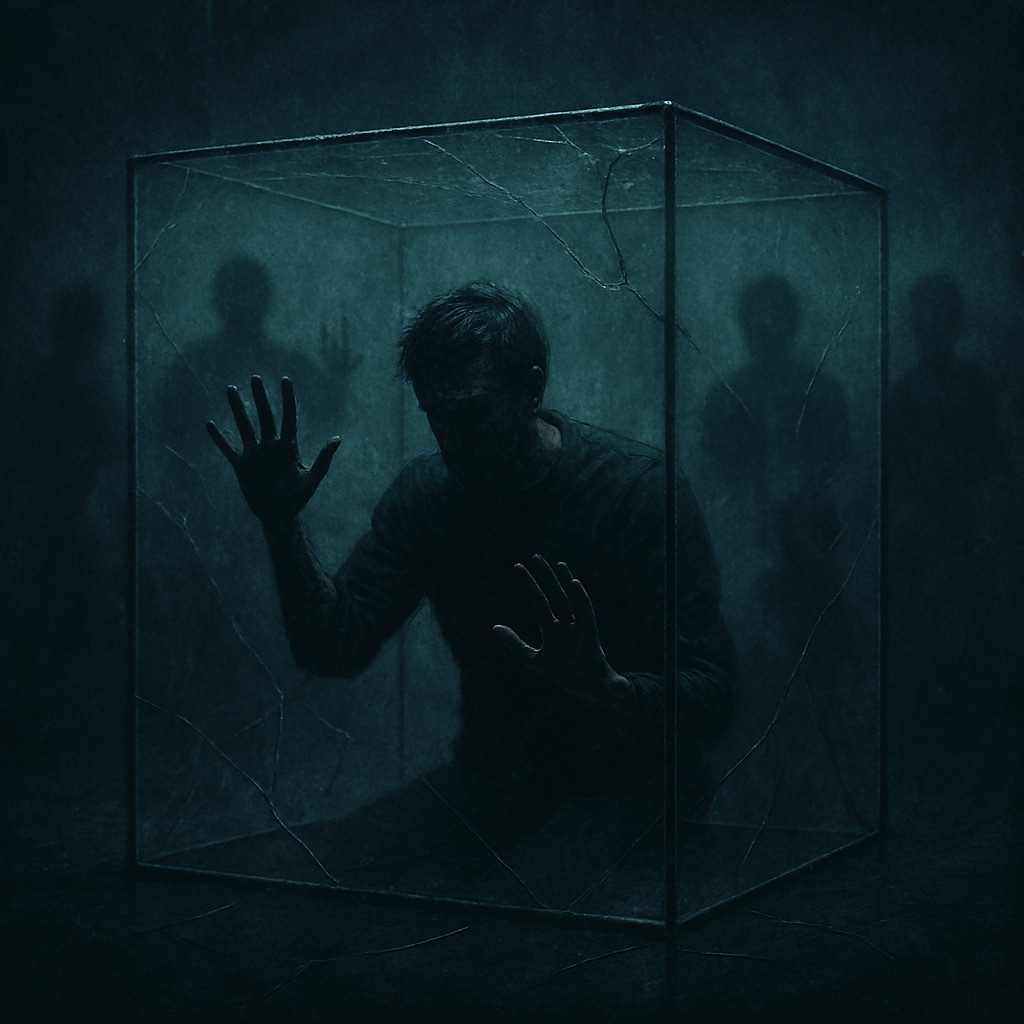
Aspect 1: The Barrier of Isolation
Invalidation. In trying to relate, people answer your pain with their own stories. They mean to empathize, but instead they erase you—flattening your experience into something ordinary, already understood. What feels like connection becomes dismissal. The more they insist they “get it,” the more unseen you become.
Overwhelming Complexity. Hell is so complex that no quick summary can convey it. Most people lose focus or disengage long before they grasp even a fraction of it, and that collapse of attention becomes another barrier that leaves you alone inside it.
Anger as a Trap. Pain breeds frustration and rage but expressing it pushes people further away. The need for connection clashes with behavior that repels it.
Nobody Cares. No one seems to care about your problems. Everyone has their own burdens, making yours another drop in an ocean of misery. In a world where attention spans last seconds, your suffering disappears unnoticed.
Incredulity. When uncontrollable forces keep causing your failures, people don’t care about the reason—only that you’ve failed. They assume you’re the problem, and their irritation mutates into blame. Any attempt to explain the underlying cause is rejected outright, because they can’t imagine a burden they’ve never carried.
Limits of Help. Even when someone reaches you, even when they understand exactly what you’re going through, it doesn’t change the outcome. No one can pull you out of hell. The gravity here is absolute. They may try to lift you, but in the end, it isn’t you who rises—it’s them who fall.
Rejection of the Barrier. Even if you point out that the Barrier of Isolation is unfolding in the very argument you’re having, they won’t recognize it as proof. They’ll perceive it as you being argumentative and dismiss it out of hand.
Voicing Despair. Speak too much of your pain, and people pull away. They call it negativity, force a smile, or vanish into silence. Every failed attempt to share your suffering wears you down, piece by piece, until speaking feels dangerous and silence begins to feel like safety.
Induced Incompetence. Hell can transform people. Those who should be allies—friends, colleagues, family—become inexplicably incompetent or obtuse. This is not ordinary human error; it is induced incompetence, a manifestation of the Barrier that ensures they cannot understand or accept Hell Theory.
Conversations become labyrinths. Simple requests collapse into confusion. The more you try to explain, the more incomprehensible you become to them.
Additionally, they will make mistakes you must pay for. They will create problems you must solve. And in many cases, you will be punished for their errors.
Suffering without support is not just harder—it is transformed, becoming all-consuming. Isolation is not a symptom of hell; it is its foundation.
Aspect 2: Burden of Relentless Trauma
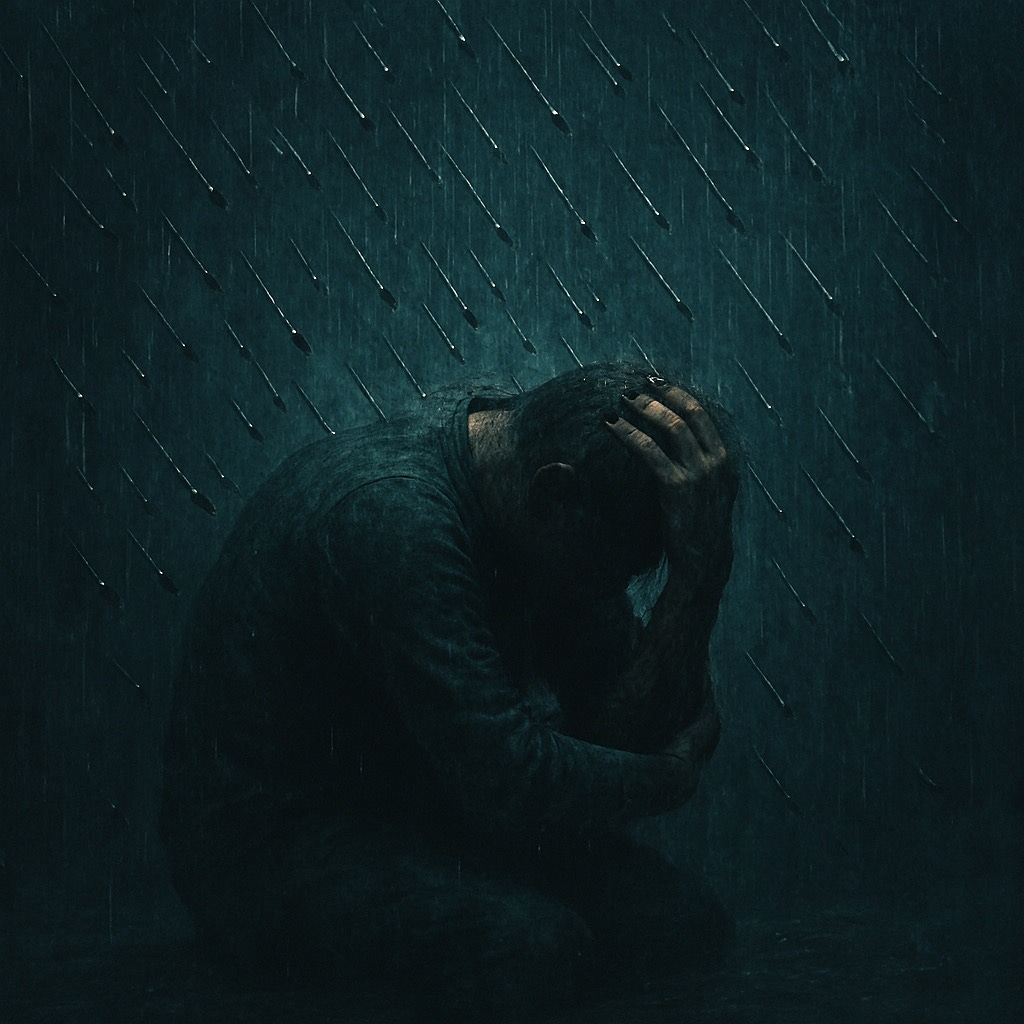
No Pause. Progress never holds. Hopeful moments collapse before recovery is possible. Stability feels not just unreachable but actively undone.
Varied Sources. The blows come from everywhere—your own mistakes, broken institutions, accidents, other people’s choices. You cannot even take responsibility for it all.
Probability Paranoia. When setbacks, betrayals, and failures pile up with such relentless frequency that chance itself feels broken, you become obsessed with the question: how can so many things go wrong for so long? The pattern grows so uncanny that ordinary explanations no longer satisfy, and you begin to entertain deranged possibilities—like you’re trapped in some malicious Truman Show or caught in the wake of cosmic malfunctions.
P-Loop Network: A web of interconnected problem-loops where each failure spawns new crises, feeding exhaustion and despair. Over time, the overlapping loops create relentless, self-reinforcing trauma with no clear exit.
The cruelest weight is exhaustion. Exhaustion drains the ability to try, turning every new problem into a collapse you’re too depleted to resist. Pain can be endured, but exhaustion dissolves agency itself—leaving you trapped in a system that keeps hitting long after you’ve lost the strength to stand.
Sometimes there is a lull, long enough to wonder if the storm has passed. That is when the next blow comes, harder than the last.
Aspect 3: The Mirage of Hope
Here, isolation and trauma converge. They drain the spirit until belief itself begins to die. First you stop believing in improvement, then in fairness, and eventually in the possibility of change.
As effort stops producing outcomes, agency erodes. Setbacks feel like rules, not accidents. Each attempt grows heavier, as if trying itself is part of the trap.
Occasionally the flicker returns. A plan works briefly, and you think, maybe this time. Then the floor gives way, revealing that even this reprieve was part of the design. Each collapse corrodes resilience until even memory of possibility feels poisonous.
Eventually, survival feels too much to ask. The body continues, but the will does not. Here, hope is not salvation—it is bait. It lures you deeper until surrender looks merciful.
Fractal of Suffering
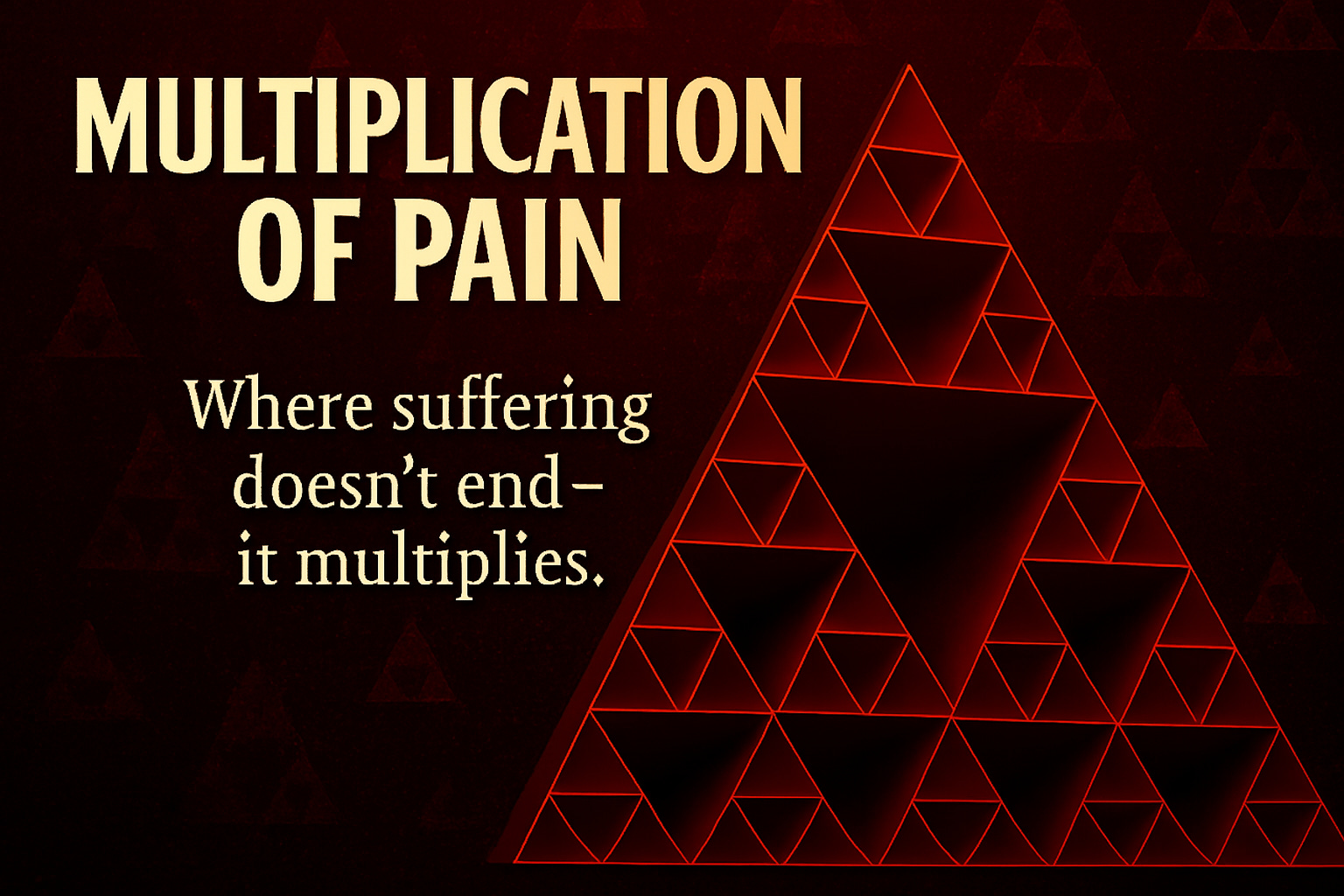
A Fractal of Suffering takes the shape of a triangle.
Each side represents one aspect:
Isolation • Relentless Trauma • False Hope
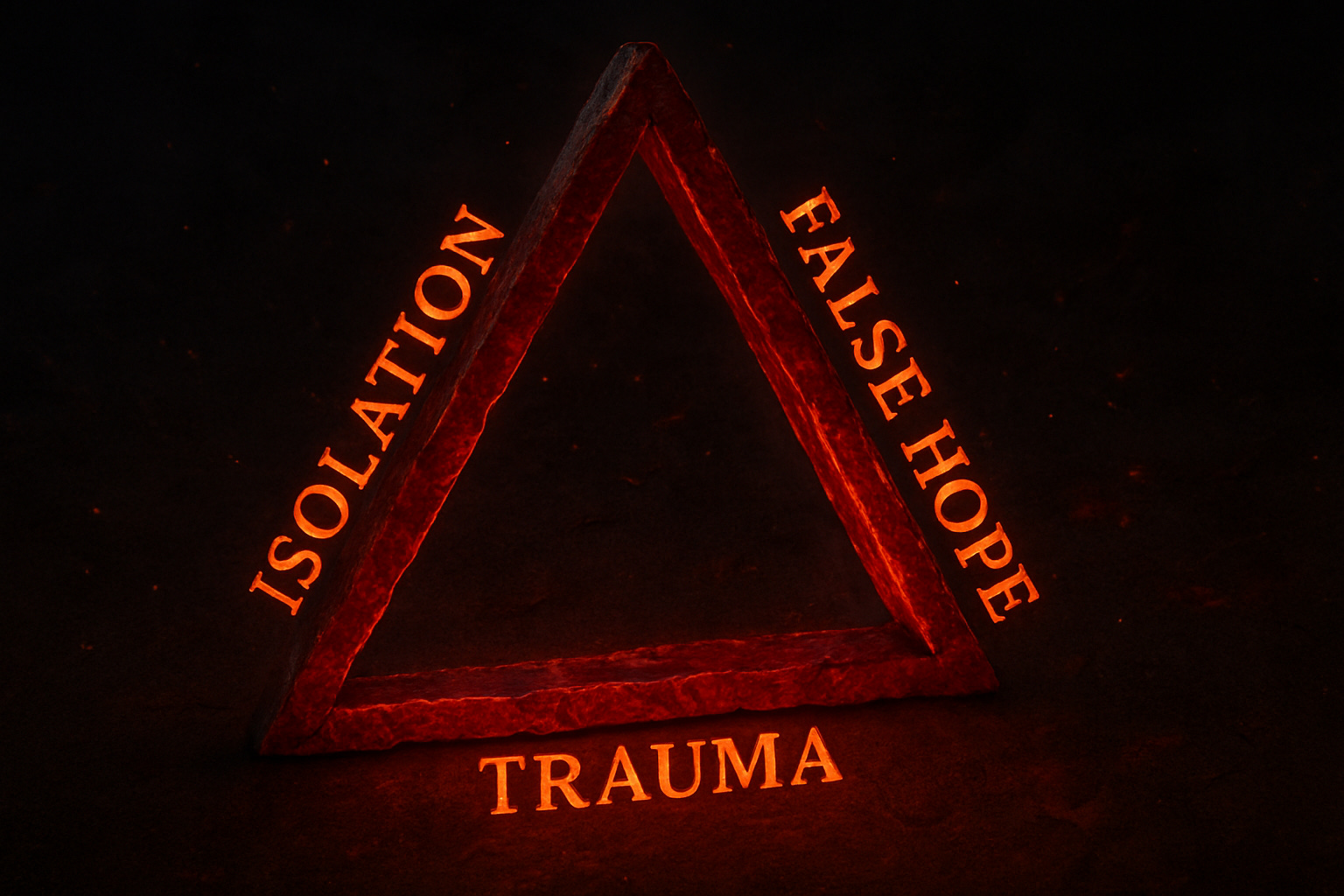
This triangle is not symbolic—it is the smallest functional unit of suffering.
And like anything that grows, it does not appear fully formed.
The sides assemble gradually, one by one, as the conditions of suffering intensify.
Formation
The first two sides—Isolation and Relentless Trauma—intensify over time.
Isolation deepens each time the person tries to explain their pain and is dismissed, misunderstood, or disbelieved.
Relentless Trauma accumulates as failures, crises, and losses continue without pause.
Eventually, these two aspects grow severe enough that they collapse into a single conclusion:
hope is no longer credible.
This is the moment when the third side—the Mirage of Hope—locks into place.
Hope as Fuel
During its formation, a fractal feeds on hope.
Hope keeps the person trying—explaining, reaching out, attempting solutions.
But each attempt fails, and each failure worsens isolation and trauma.
In this way, hope becomes the construction material of the fractal.
And when hope is finally exhausted—
when no possibility of relief remains—
the triangle closes.
The Mirage of Hope is lethal because it reveals that hope itself was the mechanism of the trap.
Micro-Example (One Loop)
A person explains their suffering →
they are dismissed →
they try again →
the dismissal repeats →
trauma intensifies →
hope weakens →
they try again anyway →
and the triangle tightens with every rotation
until eventually, they stop believing escape is possible at all.
The Self-Feeding System
Once hope is gone, the fractal no longer needs it.
Its fuel source changes.
A completed fractal generates suffering—
and then feeds on the suffering it generates.
Pain reinforces isolation.
Isolation worsens trauma.
Trauma loops back into pain.
The system becomes automatic.
Even when the victim’s effort dies,
the fractal continues.
Fractal Multiplication
One fractal rarely remains alone.
The suffering produced by the first—anxiety, fear, depression, collapse—
often becomes the soil in which new fractals form.
Over time, they spread like branching cracks in a structure under pressure.
The Final State
What remains is suffering without interruption
and the awareness that no hope is left,
not even the illusion that once kept the person moving.
to suspend the victim in ceaseless suffering,
now with the added weight of knowing they will not be rescued.
Once you see this pattern, you cannot unsee it.
P-Loops
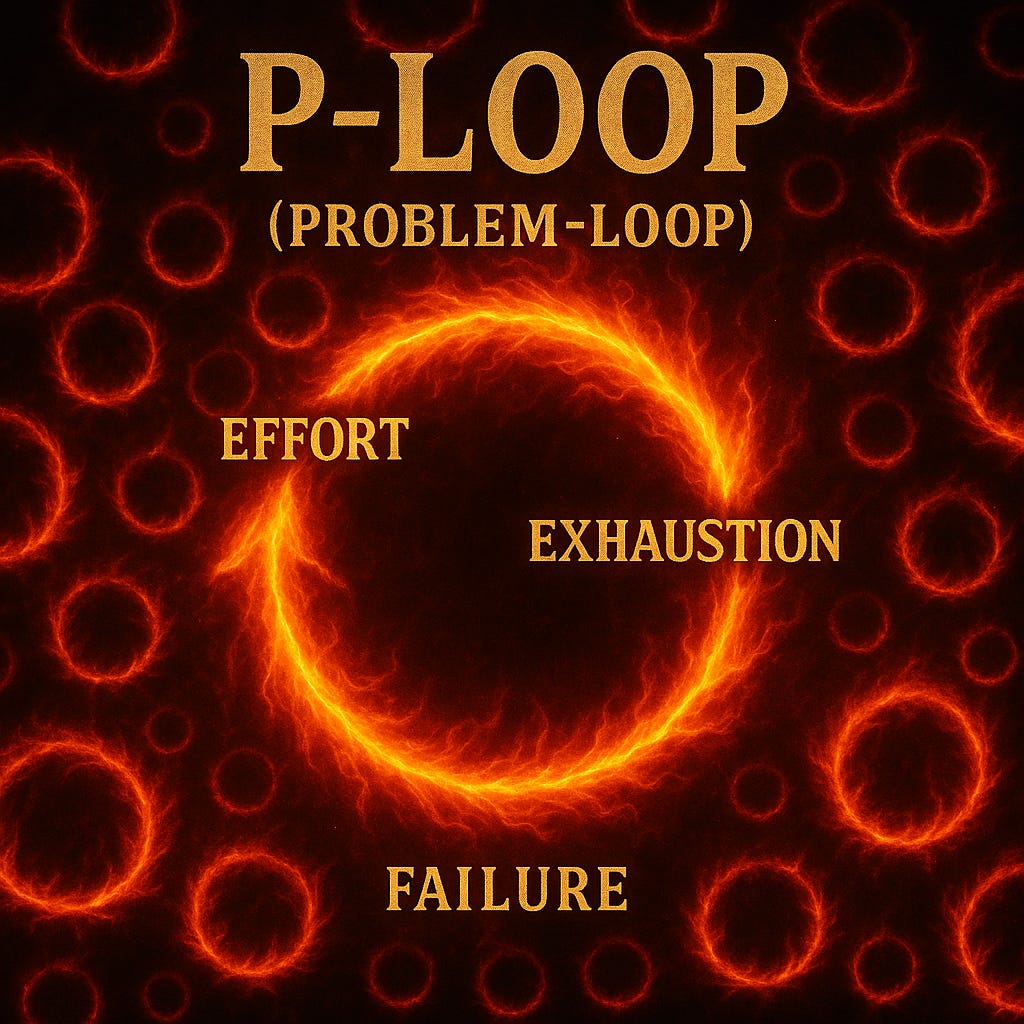
Normal problem: Effort → Resolution → Done
P-Loop: Effort → Exhaustion → Failure → Fallout → Back to Effort
With normal problems, effort closes the loop.
With P-Loops, effort sustains the loop itself.
How They Grow
One P-Loop rarely stays by itself.
Each failure creates fallout — stress, debt, exhaustion, isolation — that often links to other problems.
Health issues make it hard to work.
Job loss causes housing instability.
Unstable housing worsens mental health.
Declining mental health disrupts work and relationships.
Sometimes one loop causes another; sometimes they simply overlap. Others stand alone but still drain the same limited energy, time, and hope.
Over time, this accumulation turns isolated struggles into systems.
P-Loop Networks
Given enough time, these loops form a P-Loop network — a tangled system of problems that interact in unpredictable ways.
Some cause others, some overlap, and some remain independent but draw from the same exhaustion.
Together, these networks become the main fuel of the Burden of Relentless Trauma, turning daily life into a web of ongoing crises where even small setbacks keep everything in motion.
The Trap
P-Loops end only when effort stops feeding them. Each attempt drains more energy and spreads the fallout.
Eventually, you stop seeing problems as individual events. You see a system that no longer responds to effort at all.
That’s when the descent begins.
The Spiral
Imagine hell.
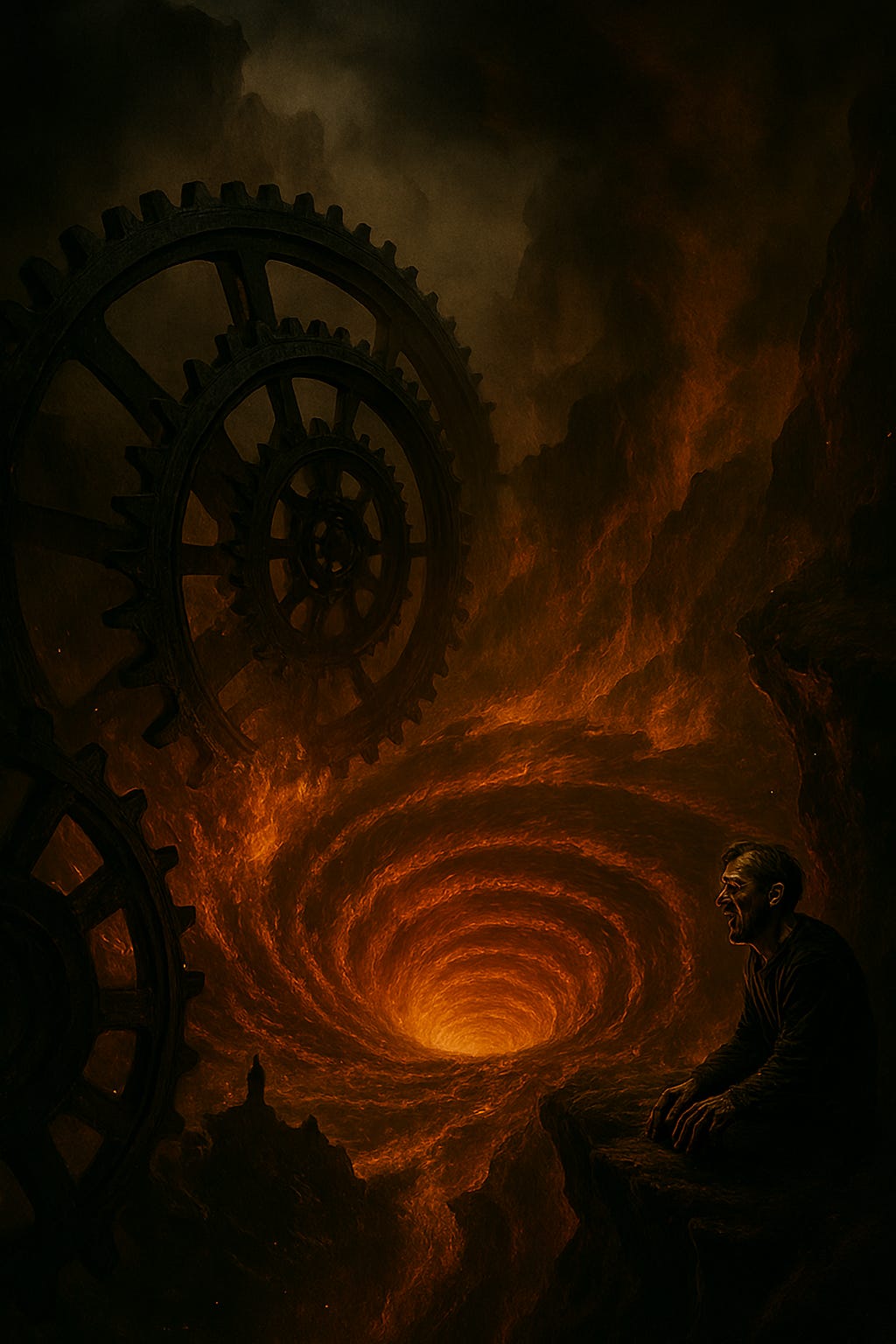
Not as fire and brimstone, but as a colossal whirlpool—spiraling, infinite, and faintly glowing beneath the surface.
At its outermost edges, a loose ring of stones and broken islands floats atop the current. Jagged, uneven—offering the illusion of safety to anyone unlucky enough to fall in.
Closer to the center, the stones thin. They stretch farther apart. Then they vanish altogether.
The current tightens as it spirals inward, gaining speed and force with every slow rotation. At the heart of the vortex lies a perfect void—wide-mouthed, black, merciless. The abyss.
There are no walls. No banks. No barriers. Only the endless pull downward.
From a distance, it almost appears navigable—a maze of footholds, crossable if one is quick and careful enough.
But closer to the abyss… there is no careful. There is no control.
There is only the spiral. The pull. The inevitable fall.
Now imagine a soul at the edge of this whirlpool.
Not stepping in willingly—caught. Swept.
First rotation—wide and slow. A misstep so small it barely registers. One moment, the ground holds. The next—it crumbles.
The current seizes him. He spins in lazy arcs. The rocks seem close. The shore feels almost reachable.
Surely, the plentiful rocks nearest the shore will save him. What are the odds he misses them all?
But he does.
After a few rotations, a rope is thrown from an unseen hand beyond the maelstrom.
He commits everything to it. Both hands. Burned skin. Locked jaw.
It slides through his grip like sand. It leaves his palms open and bleeding.
Seventh rotation. A jagged rock juts from the current like a broken tooth.
He lunges, seizes it, and the rock answers with honesty—edge into flesh, muscle from bone.
He calculates: pain now, purchase later. He chooses pain.
The current rips him free.
Nineteenth rotation. The arcs narrow. The spaces between stones widen.
Minutes blur into hours. Hours into days. Or perhaps there is no time—only the eternal now of suffering.
Consciousness fragments, dissolves, reforms in strange patterns. Memory becomes unreliable. Did he fall, or was he always falling?
He inventories the only certainty: the pain in his hands. Blood trailing behind him, marking the path like a signature.
Fortieth rotation. A larger stone rises ahead—flat, stable, the size of a raft. A platform. A miracle.
He commits his last reserves. Every nerve, every muscle, screaming in protest.
For a heartbeat, he’s certain he’s made it. He imagines lying flat, catching breath. Then the wave takes him from behind, dragging him under.
He chokes. Coughs. Sinks.
He claws back to the surface. The stone is already receding, lost to the spiral.
An exit is available: float, conserve, let the body go slack.
He refuses. He does not stop.
Later—rotations without number. There are long, terrible lapses where he makes no effort at all. The rocks are too few, too far. The current tightens.
A voice from somewhere beyond the ring says, “Pace yourself; do not panic.” You got this.
He notes the voice. He keeps working.
Another large rock appears—steady, unshaken amidst the chaos.
He rallies. He drags his ruined body forward. Closer. Closer—
The current heaves from behind. A wave lifts him like a doll and throws him against the stone.
A crack—spine snapping like dry timber.
White pain. Then the cold clarity that follows when the body cannot answer the mind’s orders.
He floats, limp and paralyzed. No longer reaching. No longer fighting.
He watches the final rock recede into darkness, unable even to raise a hand in protest.
Hope, once a scream, now whispers. Then dies.
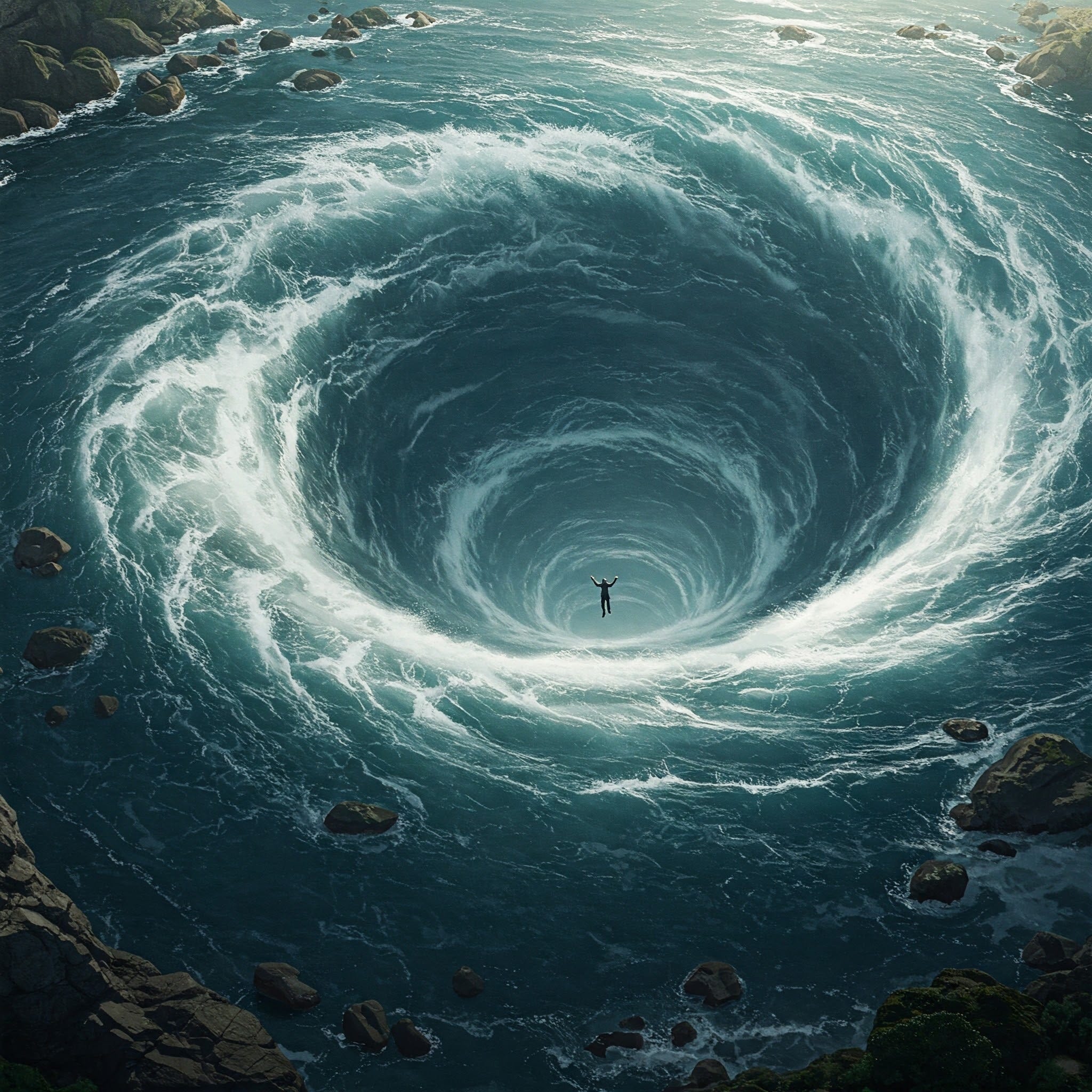
The soul passes the last stone.
Then it vanishes behind him like a dream.
He looks back—and there is nothing. No rocks. No shore. No beginning. They all vanished.
Now there is the current. Endless. Swirling. Inevitable.
Then—the truth ignites.
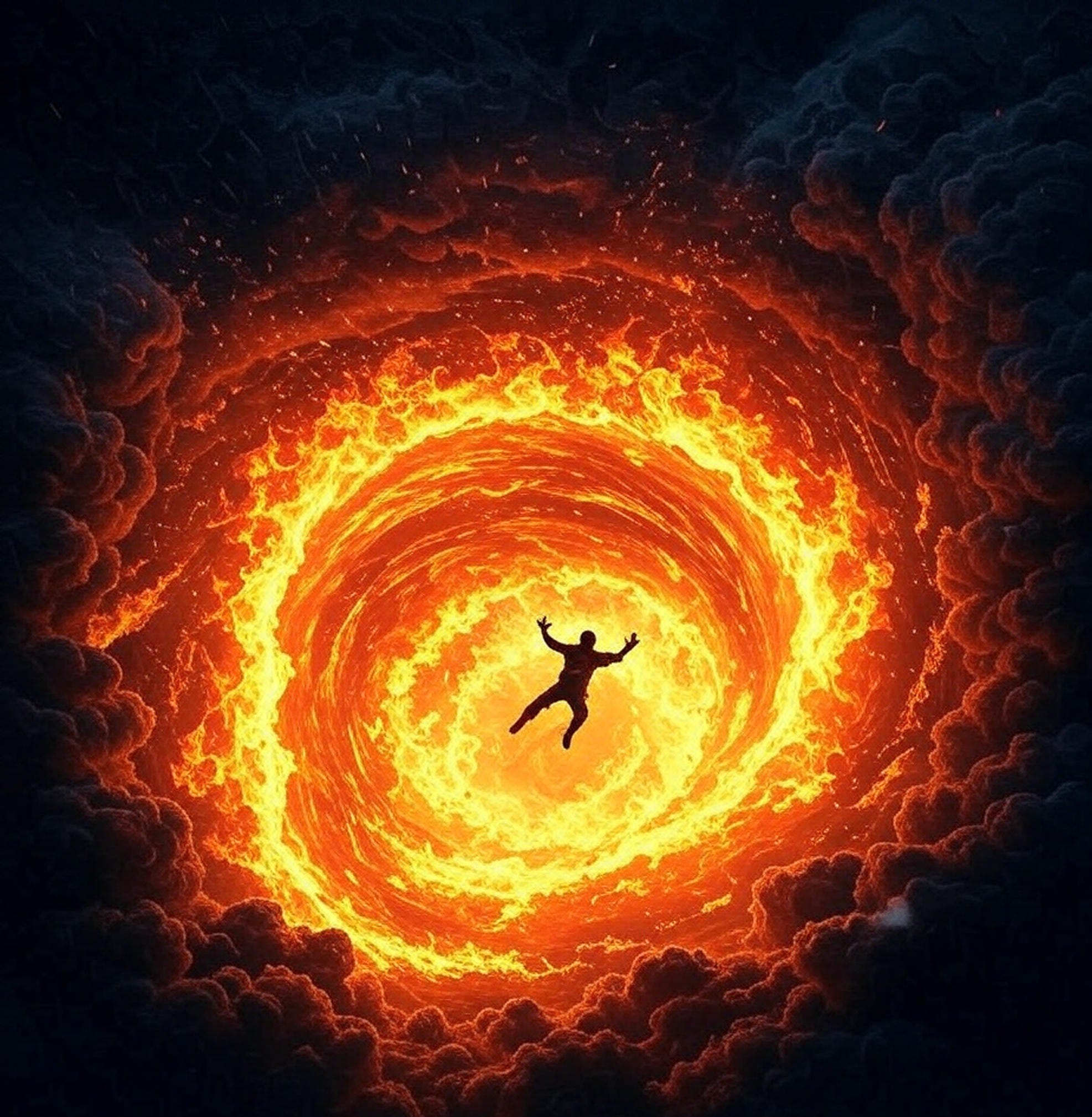
The whirlpool was never water.
It was fire.
A vortex of flame masquerading as fluid. The faint glow beneath the surface? Not light. Combustion.
The shore, the rocks, the rescuers? Not salvation. Shadows. Phantoms.
The pain does not vanish with the illusion. It persists, deepens, transforms. For pain was never in the rocks, the rope, the broken spine—but in the soul’s belief in them.
In his desperate conviction that salvation was possible. In his consciousness, that made the torment real.
There was never a way out. Only the illusion.
Only the Spiral. The heat. The slow, steady burn of hope unraveling.
The abyss does not swallow him.
He becomes it.
Hell is a Machine
The Spiral is not random. It is designed to repeat.
Hell is a machine—not built to kill, but to break. Every failure, humiliation, and trauma becomes fuel, feeding the gears.
What you see as hell is only the machine performing its function.
To call it a machine is to name its design: suffering that multiplies, fractal in pattern, infinite in recursion. The system feeds on itself, consuming and replicating until escape no longer seems possible. Live in the Spiral long enough, and the gears turn inward. Suffering rewrites the mind into despair and hate.
Sometimes the gears slow. A week without disaster. A task completed without collapse. You almost believe the machine has stopped. But the teeth are still grinding—waiting for your guard to drop.
Hell is not malice.
It is mechanism.
Conclusion
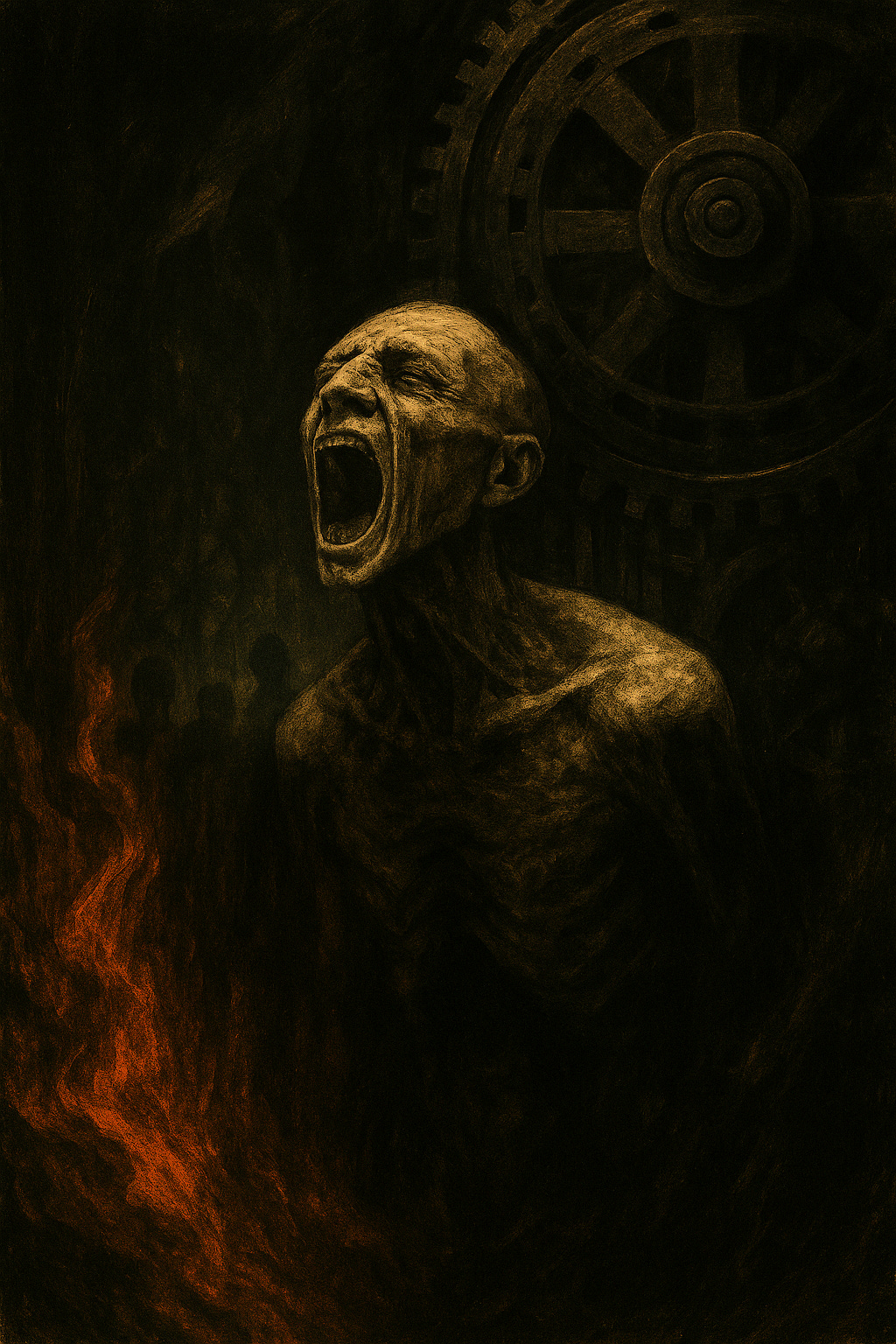
There’s no resistance left.
Screaming makes more sense. Pain demands a sound. But in Hell, your scream isn’t a signal.
It’s music.
And nobody listens. They only hum along.
Series
Part 1: Autopsy of Hope
Part 2: Multiplication of Pain
Part 3: The Collapse of Spirit
Part 4: Against Nature
Part 5: Living Fractals
Part 6: The Abyss
Part 7: Hell is a Perfect System
Part 8: The Escape