
The Abyss (Part 6)
Where the fall ends, the nightmare begins.

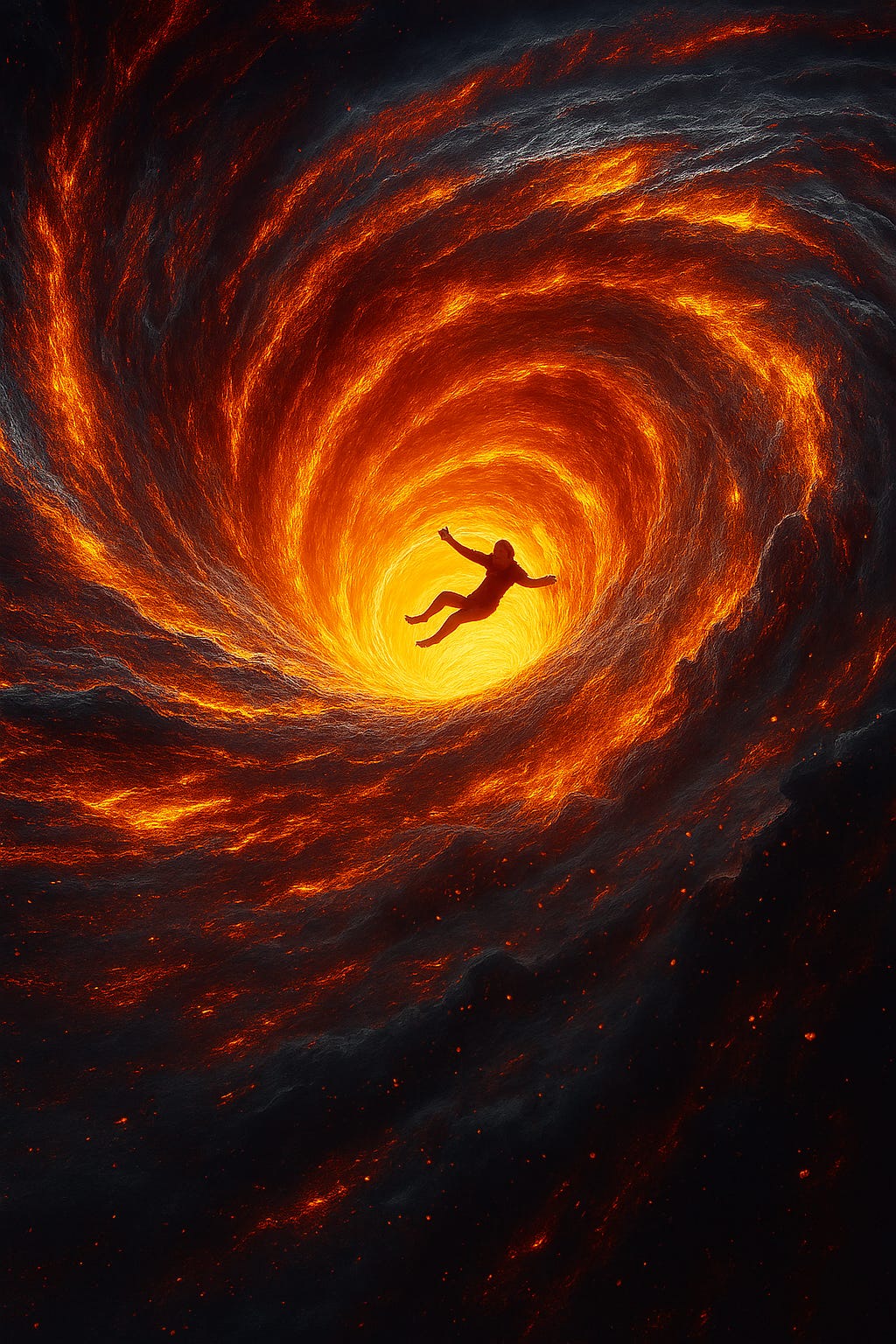
This Is My Abyss
This is my Abyss.
The last anchor is gone. What remains feels like death without release. I keep moving because I can’t stop. I breathe, I think, I ache, but the part that once wanted to live has gone silent.
The days repeat. Pain arrives on schedule. Every door that might have led out has closed. There is no joy, no love, no connection—only endurance. Every hour is another act of surviving what cannot be escaped.
There was never a life before this. There was only the Spiral, shaping each choice, each mistake, each attempt at living. Hell was not a destination but the world itself, and I have walked in it since the beginning. Each moment now is only the recognition of that truth.
The Abyss is the waiting room of oblivion, the space between life and its end. The Spiral has stripped everything but the faint, cruel hope of an ending. The horror is not what waits beyond, but that you might be kept here forever, watching nothing end.
After the Fall
In the Spiral, survival depended on struggle, and struggle only deepened the descent. When the struggle finally ends and your back is broken, the Spiral does not release you. It keeps turning. You keep moving, spiritless, drifting through the remains of existence.
The soul’s broken body drifts past the last rock—the last hope of escape. For a moment, it still believes it might reach it, but the hand no longer obeys. The current carries it forward, past the threshold, and into the dark. That moment marks more than the crossing into the Abyss—it is the mind’s surrender, the final acceptance that there was never hope at all. The last illusion dies here, and what remains is only the descent.
The Knowledge of Hopelessness
There is a special kind of despair that begins when hope dies but wanting continues. The mind still longs for an end to pain, still hungers for change, but it knows with perfect certainty that these things will never come. The knowledge is absolute; the wanting, instinctive. They coexist, and their contradiction is the torture. This is the essence of the Abyss: desire that will never be satisfied, motion without direction, suffering without purpose.
With every loss, you adapt. The mind lowers its expectations to remain functional. You tell yourself you can live with less—less joy, less dignity, less peace—until you are living with nothing at all. You endure not because endurance has meaning, but because the body is trained to persist.
But endurance does not stop the blows. Even here—broken, emptied, unable to resist—the damage continues. Life still finds ways to strike. New crises still arrive. More humiliations, more losses, more problems you cannot resolve. The world does not pause just because you are finished. Pain doesn’t become memory—it becomes weather, a constant climate of pressure and depletion. You don’t just drift—you keep getting hurt, and you lack even the strength to react.
Over time, even adaptation becomes the mechanism of punishment. Every time you survive, you confirm the system that is destroying you. You forget, recover, and continue, and in doing so, keep the cycle alive.
To see this clearly, you must look directly at the full record of your suffering—the losses, the humiliations, the betrayals, the false beginnings, the wasted years. Not to fix them, not to heal, but to recognize how complete the ruin has become. This is not an unfinished story, but a closed loop repeating itself endlessly.
What remains is not sadness but a colder realization: that all of it—every effort, every attempt, every small moment of faith—was all for nothing. From that recognition comes resentment, the only honest emotion left. Not hope, not forgiveness, but anger at the fraud of it all—the world, the promise, the lie of purpose. That anger does not save you. It only tells the truth.
Fracture
The descent does not stop at acceptance. It keeps working on the machinery.
Brief awareness lapses multiply. I hear words but cannot comprehend them. Instructions arrive and scatter. Dates, times, numbers—once simple—now slide out of place, misfiled by a mind that confabulates as it fails. The stream of thought breaks into short, vanishing segments; returning from each gap, I find the thread already gone.
Function narrows. What used to be difficult becomes rare; what used to be basic becomes difficult. I misplace, misremember, mis-sequence. Any task that requires continuity exposes the breaks. People think I am evasive or slow. I am neither. I am interrupted.
And while the mind collapses, the world keeps hitting. Bills don’t stop. Institutions don’t stop. People don’t stop making demands, mistakes, and messes you have to absorb. Trauma does not pause because you are broken. It continues automatically. You do not need to fight for suffering to arrive; you only need to stay alive.
Adaptation, once the way I stayed alive, becomes the way I accept less life. I have lowered my standard of living over and over—less safety, less dignity, less margin—until survival itself is a ritual of making do without hope. Even that was not the bottom.
The strain takes on a physical grammar. The chest tightens, pulses misfire, breath thins. It feels like the body has learned the Abyss and is rehearsing the end. I know what prolonged stress can do. I am at the age where it chooses its moment.
The mind still wants relief, but the body and brain are breaking down in the very ways that would make relief possible. The desire to get better remains, yet the strength to act on it is gone. The wish survives; the ability dies.
Simply continuing to live under constant strain is now doing the damage itself. The effects of endurance are written into the mind, the nerves, and the blood. And the world keeps turning the knife. Small crises pile up, bills accumulate, responsibilities return, and each day carves out a little more of what remains. The Burden of Relentless Trauma does not recognize surrender—it continues automatically.
What’s left is no longer a life with solvable problems—it’s a body and mind wearing out, still conscious enough to see the decline but powerless to stop it.
The System of Stillness
The Abyss is what follows after the will has been destroyed and all hope is lost. Now you are only drifting—broken and defeated. Here, suffering becomes climate: temperature, atmosphere, pressure. Pain no longer arrives—it simply is. Fear has become background noise. Thought continues, but nothing forms. You are not surviving—you are occurring.
The Abyss is not stillness. It only looks like stillness from the outside. Inside, the trauma continues—quietly, relentlessly—grinding away at whatever remains. The blows don’t need to be dramatic anymore. Small failures accumulate, minor crises drain what’s left, and each day carves out a little more of the self. A system that once required effort to destroy you now destroys you even when you do nothing at all.
There’s still a part of you—almost automatic now—that keeps you alive without effort or thought. It’s like your body has learned how to keep floating even when you no longer want it to. Because of that, you stay in situations that should be impossible to bear. Over time, you adjust to constant pain and emptiness until surviving them feels normal.
The world no longer has to hurt you actively; it has already taken you in and made your suffering part of its ordinary order.
The Mind’s Malfunction
The human mind protects itself. When pain becomes too sharp, it rewrites memory. It suppresses, reshapes, numbs. Forgetting isn’t failure—it’s survival.
In Hell, the mind’s way of protecting you turns against you. Forgetting dulls the pain, but that dullness also lets you keep going when you should have stopped long ago. What once helped you survive now keeps you trapped in the same suffering.
To “heal” here only means to keep existing inside the damage. The same resilience that once saved you now prevents release. The strength that kept you afloat has become the weight that keeps you from sinking—or escaping.
The same instinct that once helped you recover—forgetting, minimizing, adapting—now ensures your imprisonment. Without resentment, you do not fall. Without despair, you do not break. And without breaking, you cannot leave. The mind’s loyalty to survival becomes the weight that suspends you in the Abyss—tolerating what should be intolerable, enduring what should end. It is not mercy. It is malfunction.
You wake up each morning able to face another day because the mind has quietly edited the record. The sharpest edges are gone. The event is filed under “handled.” You feel functional. You go to work. You participate. The system thanks you for your resilience.
But the damage doesn’t disappear—it just moves deeper. It no longer lives in your memories but in the way you act and react. You avoid certain people without knowing the reason. You tense at specific words without remembering what they’re tied to. The wound keeps shaping you while your mind insists you’re fine.
This is what adaptation really is: learning to live comfortably with what should never have been acceptable.
The mind calls this “coping.” It confuses erasing pain with real progress and congratulates itself each time it manages to forget. It never realizes that what it calls strength has become surrender—that its talent for survival now serves the very thing that is killing it.
The Mechanism
The Abyss is the final stage of Hell’s machinery. All the previous systems—the Barrier of Isolation, the Burden of Relentless Trauma, and the Mirage of Hope—have done their jobs completely. There is nothing left for them to destroy or teach. What remains now is only the record of what they’ve done—the mind continuing on as evidence of its own ruin.
The victim continues to exist but no longer lives. The body performs its biological routines. The mind processes information. But the self—the part that generates desire, that believes continuation has meaning—has been dismantled.
This is not death. Death would be resolution. The Abyss is continuation without purpose, awareness without agency, time without hope of its ending.
The mind’s protective mechanisms, once meant to preserve life, now ensure imprisonment. Forgetting allows another day. Adaptation allows another year. Tolerance allows a lifetime. Each act of resilience becomes another rotation of the wheel.
The Abyss is the waiting room of oblivion—the space between life and its end. The horror is not what waits beyond, but that you might be kept here forever, suspended by your own survival instincts, watching nothing end.
This is the final function of the Machine: not to kill, but to trap consciousness inside the recognition of its own defeat. Aware. Broken. Enduring.
A person who lives inside the Abyss has lost all hope, and without hope, the only things left inside them are the Fractal of Suffering, the Spiral, and the Machine. Those patterns become all they experience, all they do, and eventually all they are.
Series
Part 1: Autopsy of Hope
Part 2: Multiplication of Pain
Part 3: The Collapse of Spirit
Part 4: Against Nature
Part 5: Living Fractals
Part 6: The Abyss
Part 7: Hell is a Perfect System
Part 8: The Escape