
Against Nature (Part 4)
When malice becomes nature.

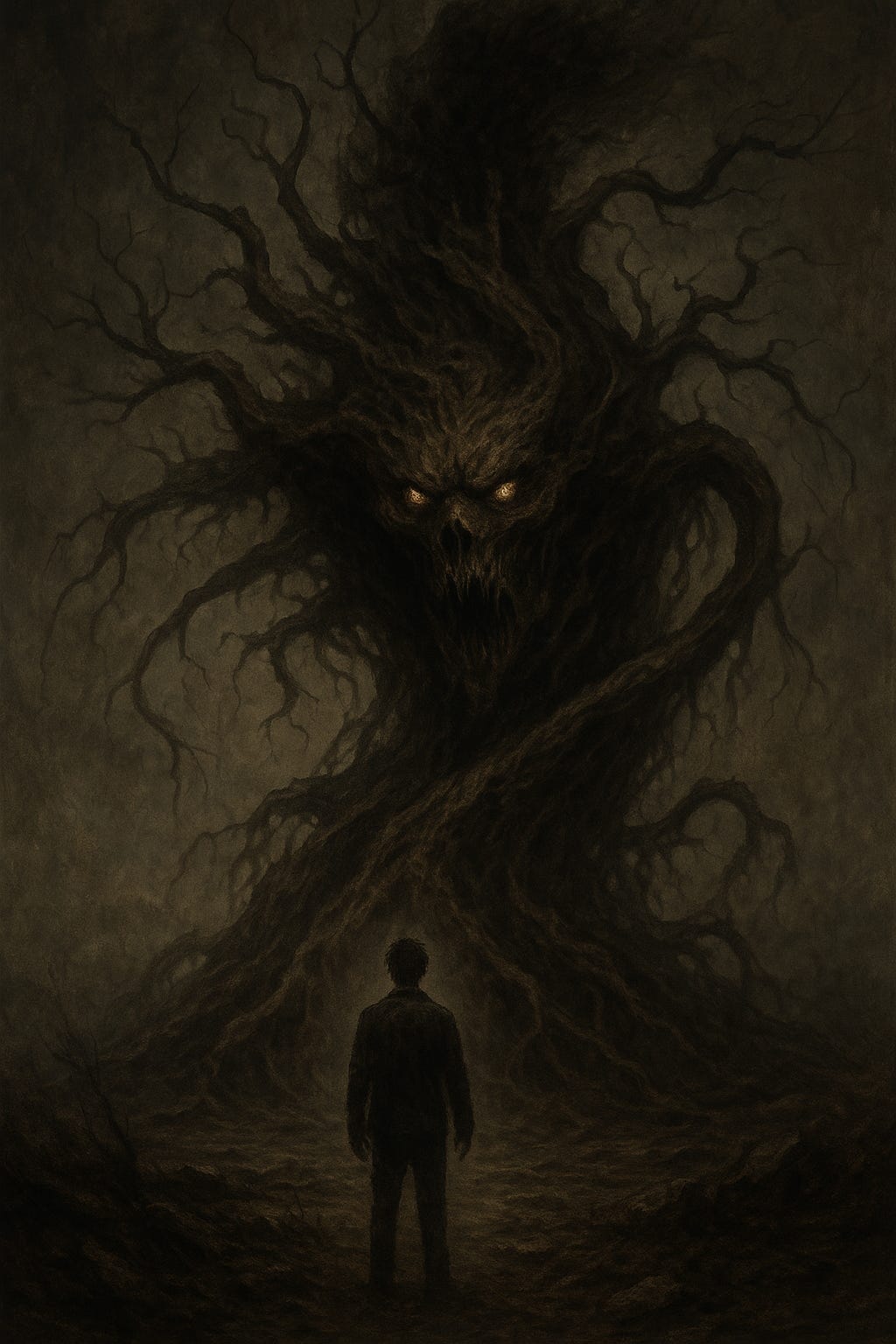
Hell is not a place you enter.
It is the rule set of the world you walk through.
Not a demon, not a curse — a pattern that behaves with the indifference of physics and the precision of malice.
It does not stalk me from the shadows.
It is the shadows.
It is the light.
It is the field I move through, and everything in that field tilts toward harm as naturally as gravity pulls down.
For years, I tried to locate the source of the hostility — a person, a system, a flaw in myself. Something I could confront, avoid, or fix.
But nothing held. Every explanation collapsed under the sheer volume of damage.
Because the truth is simpler:
Nature itself behaves like an adversary.
The External Bias of Harm
I have tracked the pattern long enough to see its ratios:
roughly seventy percent of my distress comes from the outside.
Accidents. Human incompetence. Institutional errors. Random losses. Bad timing. Miscommunications. Environmental chaos. Bureaucratic cruelty. Acts of chance that defy every sane distribution.
It happens often enough that probability stops feeling like math and starts feeling like intention.
I call it probability paranoia — not the paranoia born from delusion, but the paranoia born from accurate observation. When harm arrives too frequently to be coincidence, the nervous system adapts by assuming the world is rigged.
Because for me, it is.
The Trap of Solvable Problems
If I persist long enough, I can solve almost any short-term problem.
That sounds like hope on paper.
In reality, it’s a trap with teeth.
Hell grants the victory but poisons every step leading to it.
Most of life is spent working toward a solution, not being inside the solution.
Hell focuses its cruelty there — on the 99% of existence that is process, not outcome.
It doesn’t care whether I succeed or fail.
It only cares that I stay exhausted, anxious, and afraid.
It weaponizes my grit against me.
My stubbornness becomes the blade it uses to carve me down.
My ability to endure becomes the mechanism that keeps me suffering.
The Deathmarch of Tenacity
People tell you perseverance is noble.
Inside hell, perseverance just means you get dragged further before the collapse.
Every solved problem empties the tank a little more.
Every mile walked on broken glass teaches hell that you can handle more broken glass.
And the system never misses the opportunity.
The Wars That Matter Cannot Be Won
The small battles?
I win those.
The large battles —
the employment, the stability, the disability claim, the medical recognition, the future —
I always lose.
Not because I was incapable.
But because by the time I reach those critical junctures, I’m already shredded from the thousand small crises that preceded them.
Hell front-loads the exhaustion.
Then asks you to perform at your peak during the moments that determine your fate.
You don’t lose because of your failure.
You lose because you arrive ruined.
The Pyrrhic Life
This world trains you to survive by burning yourself alive.
You cross the finish line bleeding, shaking, missing pieces, and everyone calls it “resilience.”
But there’s a name for victories that cost more than the losses ever did:
the pyrrhic life.
A life where endurance is indistinguishable from self-erasure.
A life where survival becomes the method of destruction.
How Hell Manifests
Hell doesn’t need demons or punishment or intention.
Its brilliance lies in its ecology of harm — the way everything converges:
People’s mistakes become your fallout
Institutions fail in ways you pay for
Physical environments behave like hostile terrain
Random accidents form long, recursive chains
Your own symptoms amplify every crack in the system
Every attempt to improve your situation spawns two new crises
None of these forces coordinate.
They don’t need to.
Their convergence resembles design because the outcome is identical.
Hell is nature behaving as an adversary —
and doing so with inhuman efficiency.
The Final Understanding
You can succeed at nearly every short-term task and still have your life collapse.
Because hell isn’t interested in the tasks.
It’s interested in your total depletion.
It lets you win just enough to continue,
but never enough to escape.
It turns work into attrition,
tenacity into torment,
hope into bait,
success into exhaustion,
and life into something that technically continues
but no longer feels like living.
Hell is not supernatural.
Hell is not symbolic.
Hell is mechanical.
And it moves through nature the same way electricity moves through a wire —
everywhere, invisibly, efficiently.
This is how hell manifests.
Not as punishment.
As pattern.
Case Study
The Man the World Refused to Carry
He is the kind of man people step around.
The kind whose presence is treated like an eyesore, a warning, a stain.
His name is probably something ordinary.
But the world calls him that homeless bastard under the overpass.
He is mean because the world trained him to be.
And the world trains hardest those it intends to break.
He sleeps under concrete because the shelters won’t take him anymore.
Not for violence.
For “attitude.”
As if losing everything should have made him polite.
He does not remember when he stopped trying to be liked.
Only that every attempt cost him something he couldn’t spare.
Hell is efficient with men like him.
It strips them fast.
His day begins with the usual betrayal of the body.
Cold joints.
Stiff hands.
A cough that could belong to any century.
He sits up and the world already feels tilted.
Not metaphorically.
Physically tilted —
as if the earth itself is an inclined plane designed to roll everything away from him.
He tries to stand.
Gravity answers by adding its own contempt.
Everything he lifts weighs more than it should.
Even his own limbs feel borrowed.
This is what happens when Spirit is gone.
The body continues, resentfully.
His life is a sequence of small, external detonations.
The bus comes early.
The soup kitchen line closes a minute before he arrives.
The case worker he needed to see is out sick that day.
The replacement claims there is no record of his file.
The state website locks him out for “suspicious activity.”
The weather turns cold the one night he has no blankets.
These are not coincidences.
They are the machinery of hell using nature as its instrument.
He has learned not to expect mercy from weather or paperwork.
They hit harder than people ever did.
He tries to get a replacement ID.
The clerk tells him he needs two forms of identification to get the one he lost.
He asks how that makes sense.
She tells him “policy is policy” in the bored voice of someone who believes she has never harmed anyone.
He leaves without the ID.
The sun is too bright.
The sidewalk feels steep.
Every car sounds like mockery.
He mutters curses as he walks.
Not at people.
At the world itself.
He is not wrong.
People think he is self-destructive.
He isn’t.
He is being destroyed by a world that keeps handing him problems custom-tailored to his weakest moments.
Every mistake matters more because he has nothing left to absorb the impact.
One missed train means missing intake.
One lost glove means frostbite.
One forgotten appointment means another month on the waiting list.
One rude comment means being banned.
He is punished with mathematical precision for every error the world forced him into.
This is how hell fights a man:
not with catastrophe,
but with odds.
The cruelty is cumulative.
He once tried to get a job sweeping lots.
They told him he needed steel-toed boots.
The boots cost sixty dollars.
He had fourteen.
He collected cans for three days.
Someone stole the bag while he was in the bathroom at the park.
He screamed into the empty air until his voice cracked.
It didn’t change anything.
Hell flatters itself by calling moments like this “tests of character.”
What it really tests is endurance —
and whether the man has any Spirit left to burn.
By the end of the month, he is limping.
By the end of the year, he is something else entirely.
People see the scowl, the bitterness, the rage without context.
They do not see the 70 percent of his life shaped entirely by external forces.
They do not see how every attempt he makes is met with another structural collapse.
They do not see the probability bias bending against him like a loaded field.
They do not see that he is fighting a war no one else even recognizes as a battlefield.
All they see is an angry man with a cardboard sign.
He could have been anyone.
That is the horror.
A teacher.
A veteran.
A mechanic.
A father.
It doesn’t matter.
Once the pattern locks in, hell funnels a person downward with the inevitability of drainage.
Nature becomes the adversary.
Systems become the gauntlet.
Chance becomes the executioner.
Men like him are not simply poor.
They are hunted by entropy.
He dies quietly under the overpass one winter.
Not dramatically.
Not tragically.
Just predictably.
The city collects the body.
Someone writes “male, approximate age” on a clipboard.
His life is reduced to an entry.
His suffering is reduced to nothing.
But the pattern remains.
And the truth is simple:
He wasn’t mean.
He was exhausted.
He wasn’t broken.
He was eroded.
He wasn’t lost.
He was crushed by a world that treated his existence as a statistical inconvenience.
He did not die because he failed.
He died because hell never gave him anything he could win.
Series
Part 1: Autopsy of Hope
Part 2: Multiplication of Pain
Part 3: The Collapse of Spirit
Part 4: Against Nature
Part 5: Living Fractals
Part 6: The Abyss
Part 7: Hell is a Perfect System
Part 8: The Escape